Wednesday, September 18, 2013

Why Jurassic Park won't be opening any time soon

One of the great things about being in evolution is that I get to talk about dinosaurs every once in a while. Or, at least, things related to dinosaurs.

New research is out from the University of Manchester, published last week in PLoS One, about the likelihood of using amber preservation of insects to get ancient DNA. Amber is basically fossilized tree resin, and under certain circumstances insects (or other small creatures, like spiders) can get trapped in the resin and engulfed in the resulting amber. Here's an image of an example:

(Image credit: Paul Eccleston, published by Telegraph 20 August 2008)

Why does this relate to dinosaurs? Popular media. Michael Crichton's novel Jurassic Park was first published in 1990, and the movie adaptation came out in 1993. In this story, scientists extract DNA preserved in mosquitoes trapped in amber, and use that to clone dinosaurs, creating a really amazing zoo. Of course, lots of things go wrong (in both the book and film, though differently), and soon carnivorous dinosaurs are terrorizing the people at the park. This would, admittedly, make for an unpleasant vacation experience, but it does make for an entertaining story.

Scientifically, though, the story doesn't really hold up. In fairness, you shouldn't expect it to. Nearly no science fiction written for a general audience is particularly exacting with the scientific details. The main scientific problem with the story is that DNA degrades too rapidly for something tens of millions of years old to provide enough readable genetic information to make resurrecting something that ancient plausible. It's not just a limit of current technology -- it's that the actual material has broken down. Once it's no longer there, advances in technology won't really change that; extinction is pretty much a permanent thing.

This latest paper shows in detail how this is a problem. The research team took samples from two bees preserved in resin that had not yet fossilized into amber, and used new sequencing technology to try to read its genome without having to make copies of it first. This is an important point, as older methods relied on making many copies of the genetic material first, but the authors point out that amplification methods are more likely to amplify intact, modern contaminants than they are to amplify the fragments from really old stuff, so the amplification methods are much more susceptible to getting erroneous readings from modern DNA coating the sample. The copal, as this not-yet-amber resin is known, was dissolved, and the insects extracted. Samples were taken for sequencing, and the sequences compared to those in a database of bee sequences. One of the bees was from within the past 60 years; the other was from about 10,600 years ago -- that means bees from when your grandparents were a little younger than your age now, or bees from when agriculture was first getting going. Even on these very young samples, as far as fossils go, there were very few readable sequences, and what was there was very short. What sequences existed predominantly did not line up with the closest relatives of the bees trapped in the resin. The DNA had simply broken down too much, into too small of pieces, for it to be plausible to figure out what it originally was.

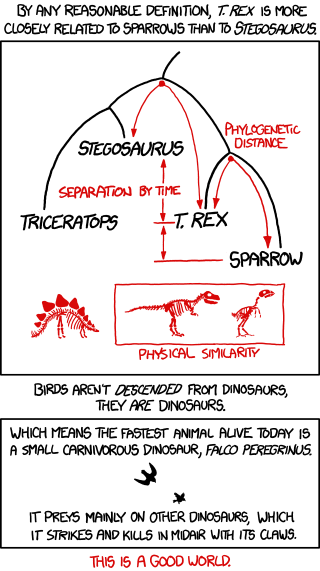
Of course, it's always a bit disappointing that dinosaurs are gone and aren't coming back. But as the excellent Randal Monroe points out, that's not entirely the case.

(Credit: xkcd, source comic: http://xkcd.com/1211/)

From a phylogenetic stand point -- meaning how organisms are related to each other -- it's not just that birds are related to dinosaurs. Birds *are* dinosaurs. This is, indeed, a good world.

Monday, September 9, 2013

Breakfast: it may not be as important as you think

I'm generally a fan of the Explainer and Medical Explainer columns on Slate.com. I feel like the Medical Explainer column is one of the most accessible forms of news about medically-relevant studies out there for a general audience. Today's installment fits that mold; this one is about the case for the importance of breakfast.

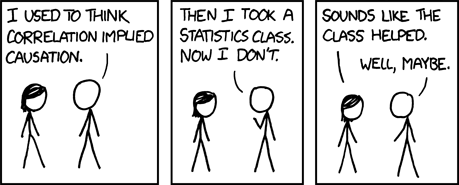
Most of us grew up being told that breakfast is the most important meal of the day, and that skipping it would lead to all sorts of problems, ranging from gaining fat to impaired mental functions. The problem is that the underlying data is merely a lot of association studies. People who skip breakfast are more likely to gain weight than people who don't skip breakfast. It could be that skipping breakfast results in weight gain, but it's also possible that people who are likely to gain weight are more likely to skip breakfast. Perhaps people who skip breakfast are dieting, and thus likely to be gaining weight (as most people go on diets because they have been gaining weight). Perhaps they are experiencing higher levels of stress, and aren't eating breakfast in order to save time. Etc. There are a lot of potentially confounding factors.


(Image courtesy of xkcd)

What could help us figure out a causal link would be a randomized trial, where individuals are told to either eat breakfast or not, and then monitored over time. This is a more expensive method of performing a study, but would reduce the other confounding differences between those who eat breakfast and those who don't.

As this article correctly points out, there is potential harm to continuing to report a standard piece of received wisdom which hasn't been properly tested. It could be that breakfast is irrelevant, but stressing that people should eat it crowds out other information that would be useful. Or, as something I'd like to point out, it's also possible that this could trigger decision fatigue. That is, if you need to make a lot of decisions, you're likely to agonize more about earlier ones on your list than later ones. So if you're the sort who doesn't like to eat breakfast, but you make yourself do it, you're exerting willpower to (you think) be virtuous -- and that virtue may make it harder for you to resist the midnight snack that you think is likely to screw up your diet for the day.

In summary: correlation does not equal causation. We scientists keep saying that, hoping that eventually others will integrate this into their thinking. We could well be wrong, but we hope so anyway. Eat or don't eat breakfast as makes sense from your own experience; the data backing the importance of breakfast is less settled than you probably think.

Sunday, September 8, 2013

Sex at Dawn, part 5

This covers part 5 of the book Sex at Dawn: The Prehistoric Origins of Modern Sexuality. (You can see my reaction to part 1 here, part 2 here, part 3 here, and part 4 here.) There are 3 chapters in this section.

Chapter 20: On Mona Lisa's Mind

This chapter marks something of a departure from earlier chapters, in that it provides citations to evidence backing its claims. There are a few major points brought up in this chapter:

1: When sheep and goats are raised by the other species, males mate with the species they are raised only, while females mate with whatever species they currently live with.

2: Female college students report lower numbers of sexual partners when they have reason to think others will be able to associate their report with a specific individual than when things are anonymous; male college students do not show any difference

3: Female humans show heightened genital blood flow regardless of the sex (or, potentially, bonobo-ness) of subjects in erotic imagery, while males show responses very much in line with their stated orientation (ie gay men respond to males, straight men respond to females).

4: Female college students show differential odor preferences for males based on whether or not they are using hormonal birth control.

All of this is taken to argue that female desire is much more inscrutable than male desire is. This may be the case. There are other possible interpretations -- genital blood flow as measured by a potentially intrusive probe may not be an accurate measure of arousal; sheep and goats are not people; changing preferences based on hormones does not mean that the preferences are inscrutable; etc. But as a first pass, I am willing to accept in arguendo that female desire is more fluid than male desire is. I'm not sure what that has to say about ancestral human sexual behavior, and I don't see this point being made by the authors. Still, I am pleased to see studies discussed and cited, even if they may not be as conclusive as portrayed to a popular audience.

Chapter 21: The Pervert's Lament

This chapter starts, oddly, with the notion that sexual frustration plays a role in destructive adolescent behavior, which from the context of the preceding paragraph appears to mean suicide. While the authors are correct that homosexual youth are significantly more likely to attempt to kill themselves than heterosexual youth are, I don't find it at all obvious that this is due to sexual frustration; I think it is much more plausible that this is due to a cultural message (which is thankfully changing) that there is something inherently wrong about homosexuality and that many consider it to be an abomination.

There then follows a long history of the attempts to stamp out masturbation at various points in American history, complete with speculation about the sexual habits and preferences of some of the reformers. I find this last section entirely distasteful, as it comes very close in my perception to an ad hominem attack -- attacking the individual, rather than the individual's ideas. While I feel campaigns against masturbation are at best foolhardy, that doesn't mean that I feel it is appropriate to attack the individuals, rather than their claims.

After this, the chapter veers further into anecdotes. One concerns a potentially fictional story about Calvin Coolidge and his wife visiting a chicken farm and talking with the farmer about how so few roosters perform the necessary duties for so many hens. Another concerns a case of infidelity known to the authors. These anecdotes seems to have little to say about wide spread patterns, as the plural of anecdote is not data.

Finally, the chapter concludes with an appeal for people to not break up marriages due to lack of sexual fidelity, or due to a desire for sex with another individual. This may be a reasonable position for some couples, depending on their own circumstances, personalities, emotions, etc. I don't feel there's much of scientific substance to say on this point.

Chapter 22: Confronting the Sky Together

This chapter is a concluding plea for people to discuss their own sexual needs with their partners, and not simply enact a script of what they think is required due to cultural pressure. I heartily endorse this idea in general -- people should communicate their needs and desires to their intimate partners, and relationships should do the best to work out what is needed and wanted by each of the individuals involved regardless of whether they are typical or not of the larger cultural idea.

My closing thoughts:

This book is largely without evidence. Many claims are made by assertion rather than synthesis of scholarly findings. Overly broad generalizations are made without the necessary support. As a popular science book, I feel it is extremely weak: it is overly confident of its own ideas; it gives the reader little sense of how science is actually conducted, or the careful claims of most respectable researchers; it routinely assumes that modern hunter-gatherer groups are perfectly analogous to ancestral ones; it tends toward extreme pan-adaptationism. I can understand why it became popular, as it is provocative and makes bold claims, but I feel it is a major disservice to science to make such claims well beyond the book's own ability to providence evidence and citations for them. I would not recommend this book for anyone seeking insight on ancient human sexual behaviors.

Wednesday, September 4, 2013

Sex at Dawn, part 4

This covers part 4 of the book Sex at Dawn: The Prehistoric Origins of Modern Sexuality. (You can see my reaction to part 1 here, part 2 here, and part 3 here.) There are 5 chapters in this section.

Chapter 15: Little Big Man

This section starts out with a discussion of body size dimorphism, which is essentially that males and females in many species are different sizes than each other. When this is true in mammals, it is nearly always that the male is larger than the female. The degree of disparity between the two sexes in size correlates strongly with the mating system -- when a single male is capable of monopolizing many females, males tend to be much larger than females, while when a species is monogamous, the two sexes tend to be roughly the same size. In humans, chimps, and bonobos, males tend to be 10-20% larger than females. From this, the authors argue that humans are naturally promiscuous, as males are not as much larger in humans as they are in gorillas, while also claiming that polygyny requires sufficient political power and wealth to support multiple wives, and that this did not exist prior to agriculture.

This is not a logical argument. Within the US, adult males about 17% heavier than and about 8% taller than adult females according tot he CDC, so that's clearly in the right ballpark. In lions, males are about 12% longer, 20% taller, and 35% heavier than females, according to this conservation site. So male lions are a little larger in relation to female lions than male humans are to female humans, but not as severe as the discrepancy between male and female gorillas. Lions are notably lacking in agricultural wealth, yet prides are typically composed of multiple females and their young, and only one or two adult males. It is not a requirement that males either be as much larger than females as is true in gorillas, or else for males to have extensive material wealth, for polygyny to be possible in a species. My interpretation of the data is that human males (as well as chimps and bonobos) have been less polygynous over evolutionary time than have male gorillas, but that does not necessitate widespread promiscuity (nor does it refute it).

From here, they segue into a brief overview of sperm competition, which they get into more deeply in the next chapter

Chapter 16: The Truest Measure of a Man

Here the authors go into more depth on the idea of sperm competition. Their take is predominantly that in species with promiscuous mating habits, male competition is not for access to mates, but instead takes place at the level of the sperm. This accounts for larger testes in such species relative to body size. There are some pieces of evidence in favor of sperm competition in humans -- relatively large testes compared to most primates (though notably smaller relative to body size than in chimps or bonobos), and greater sperm production in men whose regular sexual partners have been away for several days, regardless of the man's other sexual activities. It is, however, not a settled point, which they oddly concede in an end note to a sentence that declares that there is no question that there is sperm competition in human reproduction. They conclude with an argument from pornography, namely that scenes involving multiple men and a single woman are popular, and that women rarely demand sex-inverted scenes in their pornographic preferences. To the authors' viewpoint, this clearly demonstrates an enjoyment on the part of men for visual depictions of sperm competition. Possible. The extent to which this is a popular preference is not discussed, which means it's difficult to interpret -- it could still be a relatively small fraction of the consumed pornography. But there are many other interpretations. Fantasies that this is how individuals they idolize (sports stars, successful musicians) behave. Access to an unobtainable woman in a way that is clearly demonstrated in front of friends. Subjugation of the woman as purely a sex object, rather than a person in her own right. It's very difficult to determine motives from this sort of (lack of) data.

Chapter 17: Sometimes a Penis is Just a Penis

In this chapter, the authors talk extensively about the size of the human penis in relation to body size, noting that it's longer and thicker than in other apes, and that it has more differentiated structures on it. From here, they conclude that these are features molded by natural selection to deal with sperm competition. I am not saying that that is not a possible interpretation, but I will say it's far from the only one. This entire chapter suffers, in my opinion, from pan-adaptationist thinking. The authors assume that every feature they can measure is the result of natural selection. It doesn't have to be that way. Some things are the way they are due to chance. Or history. I can provide plenty of links to papers showing that particular features of studied genetic systems are sometimes due to chance or history, rather than being selectively advantageous in their own right. And even when things are adaptive, it is not necessarily the case that adaptation occurs because such features physically improve mating success. Mating success has a social component as well, and thus is often shaped by sexual selection: individuals of one sex (often female) choosing which individuals to mate with. Sexual selection explains a lot of features in a lot of species, such as the brightly colored feather on many male birds compared to the drabber but much more camouflaged colors of females from the same species. It could be that proto-human women had preferences for particular shapes of male genitalia, and that this resulted in the human male package as it exists today.

In specific claims, they discuss the idea that the particular shape of the human penis coupled with typical human sexual positioning creates suction the removes previous sperm from a woman's reproductive tract. I've never been convinced by this argument. Both male and female reproductive morphology is highly variable in our species; it seems very unlikely to me that there would be a particular shape and size combination that would produce such a physical effect in a high enough percentage of partners for it to have a strong enough effect to be visible to natural selection. They also then claim that differences in relative penis and testicle size across ethnic groups is due to differences in intensity of sperm competition. Yet those differences, subtle as they are, could also easily be explained by different preferences by females in different regions, which resulted in different sexual selection pressures.

Chapter 18: The Prehistory of O

This chapter is nearly entirely about the history of Western culture's dismissal of female libido and/or its punishment of sexually assertive women. As this has nothing to do with science, I don't have much of a scientific reaction to it. It's unfortunate that so many societies had issues with female sexuality, but that's about all I have to say on the matter.

Chapter 19: When Girls Go Wild

This chapter is another one rife with pan-adaptationist thinking. The argument is put forth that since human females tend to be more vocal during orgasm than males are, and that they are capable of multiple orgasms over a short period of time, this must have adaptive value since it's too costly otherwise. I don't buy that. Humans haven't routinely been prey to large organisms (though have to diseases and parasites) in a fairly long time period. It is unlikely that an ancient hunter-gatherer would become dinner because his or her screams of delight brought a jaguar down on him or her. Even if female orgasm vocalizations are adaptive (which I've seen no evidence that they are -- this could just be a general neural firing), that doesn't require the sperm competition explanation that the authors favor. It could display status. Multiple matings could promote lack of paternity certainty, and thus decrease the risk of males committing infanticide. It could be something else. Without experiments to test these ideas, they're simply just-so stories.

This chapter also gets weird. It advances the idea that human female breasts are a replacement signal for swellings at the genitals or buttocks, as the changing demands of locomotion would have made swellings in these regions problematic for a physically active woman, while the breast tissue could easily be enlarged. This is somehow tied to the notion that female ovulation isn't actually hidden because human women make more effort to appear attractive in portions of their cycle when they are likely fertile. Even if we accept that women do make such an effort, that doesn't actually refute the notion that ovulation is hidden. All it states is that sexual behaviors can be influence at an unconscious level by hormonal changes, which I think is a pretty widely recognized fact.

I am once again disappointed in the arguments made in this section. Little evidence is provided, and what evidence is provided often has little to say on what mating systems would be "natural" for humans. Arguments are made from assertion more often than from experiments, and the experiments presented are not of conclusive value.

Tuesday, September 3, 2013

Linguistic mapping

I caught a link today from a friend to a dialect quiz, which takes either a 25 question or a 140 question test and uses that to produce a map of your linguistic similarity to the rest of the country. For me, the results are for the short quiz:

and for the long quiz:

Neither of these maps is a surprise for me -- I grew up in the suburbs of Buffalo (western New York), went to college in southern California, did my first grad program in northern California, and then moved Lansing (middle of the lower peninsula in Michigan) for my PhD. Interestingly, the site also gives you a list of the 5 American cities most similar and most distant from your results, and Buffalo and Lansing are 3rd and 5th most similar to me, respectively. My linguistic similarities do line up not only with these cities, but the other places I've lived, and the degree of similarity appears to correlate strongly with the amount of time I've spent in these locations (also, both formative periods and current time are high similarity for me, which I would further expect -- I can imagine both a primacy effect, where the first way you're taught to pronounce something/taught a word for something has a larger impact than later ways, and a recency effect whereby you shift your current versions to be closer to what you've been hearing most recently.)

I've since seen a few of my friends posting their own linguistic maps, and I've noticed something striking -- what degree of similarity is represented by a particular color varies wildly from one person to another, based on the dynamic range of an individual's results. My similar ranges from 56.8 to 47.6 on the longer quiz, while the map from one particular friend ranges from 50.1 to 29.4. Therefore, while more of her map looks to be red than is true for mine, if we were to rescale things so that the every map had the same mapping (ha) from score to color, my entire map would be markedly more red-shifted than hers. One interpretation of this is that my diction is closer to Standard American than hers is, and thus has less to differentiate it from its most extremely dissimilar dictions than is true of hers. I suspect that this is probably the case, given what I've been told in the past about where newscaster speech came from and the ways in which it differs from what most people use in my hometown. Another interpretation, if you're an astrophysicist, is that perhaps my map is retreating from the viewer at a non-negligible speed.

However, these sorts of self-assessed linguistic tests always strike me as potentially problematic. Many of the questions on this particular one are going to be easily scored by anyone -- for example, whether your pronunciation of the word caramel has 2 or 3 syllables, or whether you refer to non-alcoholic beverages generically as soda, pop, Coke, soft drinks, lemonade, etc. Those don't need an expert to evaluate. But some of them get into use of the International Phoenetic Alphabet, which is an attempt to classify all of the phonemes across many languages. There was a time period, early on in doing Supplemental Instruction or acting as a Teaching Assistant, in which I strongly considered learning IPA notation in order to ensure that I would pronounce my students' names correctly; they'd only have to correct me once, I'd note down the IPA version of their name, and be fine. Then I looked into the IPA, and found that it largely rests on referencing other words, rather than having a set library of recordings of people pronouncing particular phonemes. If I have the Northern Cities Vowel Shift (which I probably do to some extent based on geography), for example, my perception of the vowels of various words could well be different than is assumed under the IPA. That makes it seem markedly less universal, to me. I'm not entirely confident that my assessment of how I pronounce words would line up with the assessment of an expert evaluating a sample of my speech.

There's still a part of me that thinks I should probably learn IPA notation for personal use in getting names correct, but since my transliteration into IPA may not be the same as someone else's, it makes it much less useful as a way to communicate to other people. I suspect that people who actually work with it professionally have some sort of standard to ensure consistency, but it's not terribly obvious what this is, at least to an outsider like me.

Thursday, August 29, 2013

Breed and Dotterrer 1916

My actual research has nothing to do with behavior, which could be a bit of a surprise given that all I've written about on here (so far) is my reaction to a popular science book about human behavior. In reality, I study the process of evolution itself, and I do so using bacteria. Bacteria offer a number of useful advantages in studying evolution: rapid generations, easy to manipulate environmental conditions, large population sizes, few ethical problems (things without neurons can't really suffer the same way tings with brains can), and the ability to freeze the population and revive it later.

With the sort of work I do, one thing I frequently need to measure is how many bacteria of a given type I have in a particular flask at a particular time. Population sizes, as I've said, tend to be very large in bacteria -- the populations I work with are typically around 3 * 10^8 cells -- and it's not really reasonable to count them all. It would also sometimes make the experiment useless, because the cells I take out to count aren't then still in the flask doing whatever it is I want to measure them doing. Instead, what I want is to use a small fraction of the population to estimate what the full population is like. I want a random sample from that population, which is pretty easy because I grow things in liquid culture and my cells aren't capable of making biofilms, so I just need to use a vortexer and make sure the liquid's mixed. Then I need to work with just a small amount of this liquid, and somehow get a reliable count of the number of cells in it.

So far, I've used the word reliable. This is because I'm a bit careful about terminology, and in science, accurate and precise have defined meanings. Ideally, I want my count to be both accurate and precise. Accurate refers to the sample number being close to the real number. Precise refers to multiple different measurements being close to each other. I made my own version of this common figure to demonstrate that, since I couldn't find one that I was sure was free to use (also, so I could ensure it was readable under different color vision impairments):

(Feel free to use this image if it's not for commercial purposes, but if you're going to just copy it I'd appreciate you attaching my name: Mike Wiser)

If the goal is to hit the center of the target, the two images on the top are accurate: if you take the average of all the shots, it will be close to the center. The two images on the left are precise: there is little scatter from one shot to the next. The lower right is neither accurate nor precise; there is a lot of scatter between the shots, and the average of all of them isn't very close to the center of the target. Scientifically, it's fairly easy to test for precision, but it's harder to know much about accuracy in a measurement.

This brings me to the paper I wanted to bring up. When I take my sample of liquid, I then dilute it and spread some of the dilution on an agar plate. Agar is basically science gelatin -- it makes the growth medium thicken and become a semisolid, rather than sloshing around as a liquid. I aim to get a dilution that has a high enough population size that I don't have so few colonies that the variation from one plate to another is larger. But I also don't want to have too many colonies per plate, since colonies can grow into each other (reducing accuracy) and because really dense plates take longer to count (and my own reliability may go down as a function of fatigue). It's long been the lore in the labs I've worked in that you should aim for between 30 and 300 colonies on a plate for reliability; whether that is accurate or precise or both is another matter. That range gives plates such as:

(Apologies to those with color vision limitations -- my work involves me counting the red colonies, and counting the pink colonies, and I realize the distinctions are not terribly visible in certain forms of color vision limitation. As above, if you'd like to use this image and it's not for commercial purposes, feel free so long as you credit my name to it: Mike Wiser)

That seems like a reasonable number of colonies on the plate. But where did this lore come from? A recent conversation I had with a labmate (Alita Burmeister) brought up that she had heard from one of the professors (formerly) down the hall from us that this came from an old study from the dairy industry. With the professor's (Tom Schmidt, now at the University of Michigan) help -- both his, and one of his collaborators (Clive Waldron), I found the paper I was looking for: Breed, Robert S and W. D. Dotterrer. The Number of Colonies Allowable on Satisfactory Agar Plates. J Bacteriol. 1916, 1(3):321-331. (full paper here) In it, the authors spread various dilutions of milk on agar plates, and counted three plates for each dilution to look for ranges in which each of the three counted plates was no more than 20% different from the average. Plates were counted after both 5 and 7 days. As expected, there is an intermediate range of colonies per plate that results in fewer discrepancies between plates than are found in plates with either too few or too many colonies. What exactly this rate of discrepancy is changes from 5 to 7 days, but the general finding is robust. To quote the authors, "Plates having less than 30 colonies or more than 400 colonies show very large percentages of discrepancies." Further, the type of discrepancy changes; plates with an average of 50 or fewer colonies tend to have discrepancies from one or more plates having more than 20% more than the average, while plates with an average of 200 or more colonies have discrepancies from one or more plates have more than 20% fewer colonies than the average.

I think it can be interesting at times to track down these old bits of lore to see who actually did an experiment or made an observation that became a standard part of normal practice within a lab.

Wednesday, August 28, 2013

Sex at Dawn, part 3

This covers part 3 of the book Sex at Dawn: The Prehistoric Origins of Modern Sexuality. (You can see my reaction to part 1 here. and my reaction to part 2 here.) There are 4 chapters in this section.

Chapter 11: The Wealth of Nature: (Poor?)

This chapter largely covers errors in the thinking of Thomas Malthus and Thomas Hobbes. Malthus used the growth rate of Europeans in the Americas from 1650-1800 to calculate that human population would double every 25 years. This is not a growth rate that humanity has experienced for the majority of its existence -- were it the case that human population doubled every 25 years at all times in history, and world population was roughly 1 billion in 1800 (Wikipedia, for good or ill, posits 1 billion as human population in 1804), that would work out to fewer than 1 person in 1050. Doing the same calculation from today's 7 billion in 2013 would result in fewer than 1 person in 1188. [I ran these calculations; they're not directly in the chapter.] Obviously, those numbers are wrong, so something's up with the growth rate. Instead, they cite sources that the global human population went from about 10,000 protohumans to about 4,000,000 modern humans over 2 million years of being hunter gatherers. Similarly, they attributed Hobbes' view of human nature to his historical context of warfare and religious persecution in England, and in Europe more generally.

They then make the argument that global populations were low, and therefore resources were not scarce. The argue ovulation in hunter gatherers doesn't start until late teens, children are breastfed for 5-6 years at a time, and conception is rare during breastfeeding. All are largely true, though that last point is actually dependent on overall nutritional status of the mother -- family planning based on breastfeeding is hardly foolproof (which I say as a younger child born more rapidly than planned on based on such assumptions: I am a year and 4 days younger than my breastfed brother; you do the math). Still, let's take those numbers at face value. Assuming ovulation beginning at 18, menopause in mid to late 30s, 6 year intervals on birth, that would be a child at ages 18, 24, 30, 36, so likely 4 or 5 child per woman. Assuming some premature deaths and the occasional sterile individual, let's say that means 3 surviving children per woman. That is still enough for a 50% population increase every generation, which is around 27 years. Changing the calculation to a 50% growth every 27 years, the 1 billion people in 1800 would get down to approximately 1 in 882. These factors alone cannot possibly explain how low the human population growth rate was. As the authors argue that humans were spreading into an open ecological niche (and thus weren't locked into a struggle against one another for scarce resources), something else must have been going on.

Basic biology argues that a population expanding into an open ecological niche will rapidly expand in population. The reasons why a population would not be expanding in size are largely limited to:
1: There is a high death rate (predation, disease, challenging physical environment, etc)
2: They have already reached carrying capacity of the system (and thus aren't expanding into an open niche)

The authors then go on to recount stories of a) a few specific communities of an Italian region and their descendents in the new world who were remarkably egalitarian and showed low rates of heart disease, and b) individuals from Tierra del Fuego who had been brought to England to be "civilized", then returned to their homeland and giving up the trapping of Western civilization to return to the normal way of life of their people.

Overall, this chapter's numbers do not make sense, and don't really do much to bolster arguments about what prehistorical human sexual practices were like. There are also repeated assertions that ancestral humans were fundamentally nomadic, but there isn't evidence provided to back this up.

Chapter 12: The Selfish Meme (Nasty?)

This chapter starts with a discussion of the Prisoner's Dilemma. For those unfamiliar with it, it's a basic starting point of a lot of game theory. Imagine that you and another person are brought in by the police for questioning. They tell you that they have some evidence of the two of you committing a crime, but can't *quite* prove the top count. If you rat out the other guy, he'll go to jail for 10 years, while you walk free. If you both stay silent, you'll be convicted of lesser charges and go to jail for 6 months. And if you both talk, you'll both end up in jail for 5 years. They're offering the other guy the same deal. What do you do?

If you're playing the game just once, the correct answer is to rat the other guy out. Why? Well, let's say you have no idea what your partner will do. If he keeps quiet, if you rat him out you go free; if you keep quiet, you go to jail for 6 months. Ratting him out looks better. If he rats you out, if you keep quiet you go to jail for 10 years; if you rat him out, you go to jail for 5 years. Again, ratting him out is the better deal. No matter what he does.

As expected, when you experiment with people and offer them this sort of situation, most people pick to rat the other guy out. The authors then discuss some of the work of Robert Axelrod, showing that if people play the game repeatedly, they start cooperating a lot more often, as they don't want to develop the reputation of ratting the other guy out. This is because they are no longer playing Prisoner's Dilemma -- they are playing Iterated Prisoner's Dilemma, which is a different game. Now they aren't looking for the one-off reward, they're looking to maximize their long-term payoff, and people who can get into long strings of cooperation do better. There is extensive mathematical literature on this in both evolutionary biology and economics. Memory, the ability to select one's partner, and spatial structure are all widely-recognized ways to promote the evolution of cooperation in an Iterated Prisoner's Dilemma.

They then go on to discuss the problems of the thought behind the Tragedy of the Commons. This is another frequent concept in evolutionary biology, this one derived largely from a 1968 paper by Garett Hardin. The idea is that when you have private ownership of some resource (for example, cattle herds) which consume a public resources (in this case, grazing in the common areas), then it will be in each individual's best interest to over-exploit the common resource since the pain of lowered production is shared by everyone, while they reap the profits of their extra cattle. In essence, the pie is getting smaller, but they're getting a larger fraction of it and thus still coming out ahead. Therefore, public resources need some sort of policing mechanism or else the whole system crashes.

As the authors point out, the actual commons being discussed do have policing mechanisms. This doesn't invalidate the general point of tragedy of the commons, it just limits what commons it refers to. Several of the items they list -- open seas, skies, rivers -- are seen as the relevant commons in much of the theoretical discussion of tragedy of the commons these days.

The authors then tie in the work of Robin Dunbar, who argues that with groups larger than about 150 people, individuals do not all know each other and each other's relationships within the group, and social cohesion breaks down. I've always been a bit skeptical of the notions of Dunbar's number as a tipping point, but that's merely a personal reaction and not a fleshed out scientific response.

The chapter then goes on to discuss possible evidence of the detrimental effect of agriculture on humans -- increase in chronic malnutrition, vitamin and mineral deficiency, increased time spent working for food (based on time usage of modern groups, which they assume is the same as was true for ancestral groups -- an assumption I continue to have problems with), and the small sizes of medieval European armor equating with short people. I do know from my college history classes that there is widespread belief among historians that the preserved armor from medieval Europe was the armor made for display, not use, and thus wasn't crafted at full size, but these authors do cite evidence of pre-agriculture peoples in Greece and Turkey being slightly taller than modern residents of those countries.

After this, the chapter goes on to discuss some potential evidence of the benefits of more relaxed ways. Work by Frans de Waal and Denise Johanowizc on two species of macaques -- one typically aggressive, and one far less so -- where they showed that by housing them together they could shift the more aggressive species markedly less so gives a distant primate example that aggressiveness can be socially modulated. And work by Robert Sapolsky (disclaimer: I had a friend who worked in his lab while we were both in the grad program at Stanford) on a field cite of baboons showed that a fluke event which killed off the majority of the aggressive males in the study population but left the others alone resulted in long-term decreases in aggression in this population, even so long after that virtually all of the males in the current population immigrated from other ones.

I find this chapter to either involve a misleading oversimplification of some basic points of game theory, or else to show a misunderstanding of those points. It continues to insist that hunter-gatherers would have had low stress, high leisure societies, but I don't think they've actually demonstrated this about ancestral human groups.

Chapter 13: The Never-Ending Battle over Prehistoric War (Brutish?)

This chapter starts with a criticism of a TED talk by Steven Pinker, in which Pinker discusses percentage of male deaths due to warfare in various societies, all of which are higher than the US and Europe in the 20th century. Most of these other societies are at least partially horticultural societies, which grow substantial crops, and this I feel is a worthwhile criticism of them representing hunter-gatherer societies. I am less convinced of the relevance of the objection that they aren't completely nomadic, as I don't think the authors have actually established that ancestral humans were entirely nomadic.

Next, the authors turn to the lack of bonobos in the discussion of the deep history of warfare and rape among our ape ancestors. While I feel this is somewhat justified in the discussion of warfare -- as warfare discussions among non-humans are typically limited to just chimpanzees, and there's no compelling reason to think our ancestors were more like chimpanzees than like bonobos (and, conversely, no compelling reason to assume the opposite either) -- I feel it isn't particularly compelling in the case of bonobos, as the discussion of rape among apes does include gorillas and orangutans. From a phylogenetic context, it's more likely that something seen among all apes other than bonobos is something the bonobo lineage has stopped doing since separating from the chimp lineage, rather than that the lineage to humans-chimps-bonobos stopped doing and which the lineages leading to chimps and leading to humans both later reacquired.

The book then goes on to discuss the work of Margaret Powers, who called into question some of the findings of Jane Goodall on the chimpanzees at Gombe. Notably, Powers argues that the increased aggression observed at Gombe after the first few years of the study could be laid at the feet of the researchers provisioning the chimps with hundreds of ripe bananas each day during a limited window of time each day. That creation of a highly valuable, physically and temporally restricted resource gave the chimps something to fight over, and may have led directly to the aggression observed. This is a valid point. Unfortunately, they then take this too far in their attempts to apply it to humans, such as their statement that "women and men would have been free to move among different bands in the fission-fusion social system typical of hunter-gatherers, chimps, and bonobos." (p. 191). Maybe. But immigrants in all of these groups end up at the bottom of the social hierarchy (and in both chimps and bonobos, immigrants of only a single sex are typically accepted), and social status has substantial effects of reproductive success.

The authors then go on to discuss how increasing population density appears to be strongly linked to increasing aggression. This seems logical to me. But why would a switch to agriculture automatically lead to higher population density? The authors have argued extensively that foraging resulted in better health, and less malnutrition, than in agricultural societies. If population growth was extremely slow in foraging groups, and agricultural groups had worse health outcomes, how would they have had substantially higher population sizes?

The authors then effectively point out the problems with Napoleon Chagnon's study of the Yanomami people. This take down is well sourced and logically compelling.

It seems to me that many of the points of this chapter are predicated on the assumption that ancestral foragers were inherently nomadic, which I continue to have problems with since I don't feel the authors have documented evidence that this was the case.

Chapter 14: The Longevity Lie (Short?)

This chapter starts out with a reasonable description of how the mean doesn't always give you a useful number about something. Specifically, life expectancy at birth won't tell you much about typical life span if there is high infant mortality -- the mean will be a lot lower than what is typical for people who make it to adulthood. This is completely true. They go on to state that a lot of infant mortality once attributed to starvation and disease probably resulted from infanticide. No citation provided on this in ancestral groups, but rates of 20-50% are reported for several modern forager societies. That is extremely high. Infanticide rates of 50% would have been enough to keep foragers from rapidly filling an open ecological niche, but that would argue that the switch to agriculture isn't what led to the problems associated with population density and resource scarcity, but instead that these are due to a reduction in the voluntary killing of infants. That paints the whole thing in a rather different light.

The authors then go on to talk about how many deadly human diseases come from domesticated animals. This is definitely true in general, though I do disagree with one of their claimed ones: malaria. Given that almost all malarial cases are caused by infected mosquitoes biting humans, and that mosquitoes pick up the infectious agent from many different reservoir sources, I don't think this can be laid at the feet of animal domestication in the way that measles, tuberculosis, smallpox and the like can. It's also clearly not going to apply to all the types of diseases that have plagued humanity. Cholera, for example, becomes more common at higher human population densities, but the causative agents can also live quite well in the environment, and drinking water that has the relevant bacteria in it can cause an initial infection.

There follows a discussion of stress, which the work of Robert Sapolsky, among others, has shown to be quite damaging to health. I have no quibbles with this. I don't, however, feel that they have shown conclusively that chronic stress was lower in prehistoric foraging societies than in agricultural societies, so I'm not confident of the conclusions they draw based on that assertion.

The authors conclude this section with an argument that appeals to the past as terrible and the present as markedly better are inherently conservative, as they deflect criticism away from any current organization of society. They assert that a dispassionate review of the evidence shows that the tens of thousands of years before agriculture were marked by "robust health, peace between individuals and groups, low levels of chronic stress and high levels of overall satisfaction for most of our ancestors." I would argue that a dispassionate review of their own claims and (lack of) evidence to back them up shows that their arguments are flawed, and that they don't have evidence that actually supports many of their assertions about the prehistoric social environment. I don't feel they've clearly established what the ancestral human social environment was like, and thus claims based on this purported environment are going to be dubious.