New research is out from the University of Manchester, published last week in PLoS One, about the likelihood of using amber preservation of insects to get ancient DNA. Amber is basically fossilized tree resin, and under certain circumstances insects (or other small creatures, like spiders) can get trapped in the resin and engulfed in the resulting amber. Here's an image of an example:

(Image credit: Paul Eccleston, published by Telegraph 20 August 2008)
Why does this relate to dinosaurs? Popular media. Michael Crichton's novel Jurassic Park was first published in 1990, and the movie adaptation came out in 1993. In this story, scientists extract DNA preserved in mosquitoes trapped in amber, and use that to clone dinosaurs, creating a really amazing zoo. Of course, lots of things go wrong (in both the book and film, though differently), and soon carnivorous dinosaurs are terrorizing the people at the park. This would, admittedly, make for an unpleasant vacation experience, but it does make for an entertaining story.
Scientifically, though, the story doesn't really hold up. In fairness, you shouldn't expect it to. Nearly no science fiction written for a general audience is particularly exacting with the scientific details. The main scientific problem with the story is that DNA degrades too rapidly for something tens of millions of years old to provide enough readable genetic information to make resurrecting something that ancient plausible. It's not just a limit of current technology -- it's that the actual material has broken down. Once it's no longer there, advances in technology won't really change that; extinction is pretty much a permanent thing.
This latest paper shows in detail how this is a problem. The research team took samples from two bees preserved in resin that had not yet fossilized into amber, and used new sequencing technology to try to read its genome without having to make copies of it first. This is an important point, as older methods relied on making many copies of the genetic material first, but the authors point out that amplification methods are more likely to amplify intact, modern contaminants than they are to amplify the fragments from really old stuff, so the amplification methods are much more susceptible to getting erroneous readings from modern DNA coating the sample. The copal, as this not-yet-amber resin is known, was dissolved, and the insects extracted. Samples were taken for sequencing, and the sequences compared to those in a database of bee sequences. One of the bees was from within the past 60 years; the other was from about 10,600 years ago -- that means bees from when your grandparents were a little younger than your age now, or bees from when agriculture was first getting going. Even on these very young samples, as far as fossils go, there were very few readable sequences, and what was there was very short. What sequences existed predominantly did not line up with the closest relatives of the bees trapped in the resin. The DNA had simply broken down too much, into too small of pieces, for it to be plausible to figure out what it originally was.
Of course, it's always a bit disappointing that dinosaurs are gone and aren't coming back. But as the excellent Randal Monroe points out, that's not entirely the case.
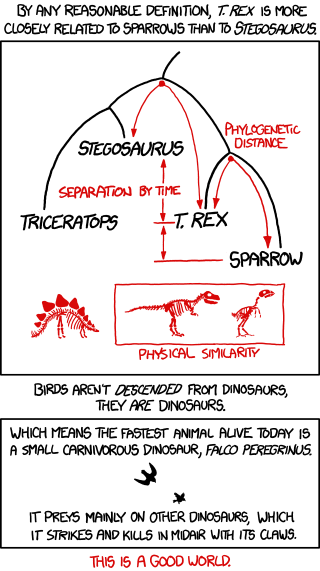
(Credit: xkcd, source comic: http://xkcd.com/1211/)
From a phylogenetic stand point -- meaning how organisms are related to each other -- it's not just that birds are related to dinosaurs. Birds *are* dinosaurs. This is, indeed, a good world.

No comments:
Post a Comment